
Report on New York City Housing Court Article 12 Guardian Ad Litem Program: Compensation and Working Conditions

April 2025
I. EXECUTIVE SUMMARY
In New York City Housing Courts, the Article 12 Guardian Ad Litem Program (“GAL Program”) provides trained advocates to litigants who are incapable of defending their rights to assist with a wide range of interventions to prevent eviction. However, their work is limited by structural barriers including insufficient funding, and lack of access to technology and court space. To adequately protect the rights of litigants with diminished capacity, the GAL Program should fully fund each case where a guardian ad litem is appointed, include mechanisms to regularly update compensation, and provide access to technology and government systems, office space in the court houses, and logistical support. Such improvements would also address GAL concerns of professional recognition and recruitment.
II. INTRODUCTION
Guardians Ad Litem are court-appointed officers in civil actions where a party is unable to adequately prosecute or defend their rights.1 “The guardian ad litem is an officer of the court with powers and duties strictly limited by law and he may act only in accordance with the instructions of the court and within the law under which appointed.”2 Guardians Ad Litem (“GALs”) serve vulnerable populations and protect fundamental fairness in the legal system. This is especially true in the Housing Part of the NYC Civil Court, where the possessory nature of the proceedings can jeopardize an individual’s right to continue to live in their homes. The current GAL program in Housing Court, authorized by CPLR Article 12, began in 2003 to organize a pool of volunteers to serve as guardians ad litem.3 In the years that followed, both the Court and the public recognized the importance of GALs to address due process issues faced by those interacting with the legal system, including physical and mental health challenges, and established best practices for GALs. A key public policy imperative of today’s GAL program is eviction prevention. Due process and the statutory authority under CPLR 1201 to appoint a GAL requires the court administration to
THE ASSOCIATION OF THE BAR OF THE CITY OF NEW YORK 42 West 44th Street, New York, NY 10036 212.382.6600 | www.nycbar.org
maintain a pool of trained and dedicated GAL professionals. Attracting and retaining qualified and motivated people to be a GAL is in the public interest.
In Housing Court, Article 12 Guardians Ad Litem are appointed for adults who lack sufficient capacity to “help protect their wards’ rights for the action or proceeding.”4 As temporary appointed officers of the Court, they maintain a dual responsibility to both the Court and the wards they serve.5 The work of GALs presents unique and varied challenges, including: navigating complex court proceedings; engaging City agencies for resources and services; managing a ward’s participation in court and compliance with cure; balancing self-determination and the best interest of a ward; locating wards and assisting them in getting to City agencies, physicians, social workers and others for needed assistance; assisting them with completing recertifications required by certain landlords; and extensive travel around the City of New York. Commonly, proceedings with GALs in the NYC Housing Court require multiple court appearances. The issue leading to insufficient capacity of a ward “might be cultural, linguistic, physical, intellectual or psychological.”4 One of the most important and challenging parts of a GAL’s work is communicating effectively with their wards, educating them and creating avenues for increased participation in the defense of their rights.
Despite their critical work, GALs have for years operated largely independently, without formalized support or resources from any agency or the court. We are encouraged by the Court’s recent announcement of the appointment of GAL Coordinator. However, it is widely understood that the “GALs on the roster are overworked and under resourced” and that their pay “falls far below the compensation level needed for the work required to meet the ward’s needs.”6 The amount of time and resources a GAL must devote to a guardianship assignment depends on the individual circumstances of each person they serve. For GALs to continue performing their integral function in Housing Court, the GAL Program must be improved to include adequate support resources. This includes full compensation for all cases, and confidential spaces in Housing Court with appropriate technology. These conclusions are based on outreach and discussion with a pool of fifteen active and experienced GALs and are explained in more detail below.
III. INADEQUATE COMPENSATION
Despite Housing Court’s reliance on GALs to protect fundamental fairness and due process rights of vulnerable populations, as well as the public interest in eviction prevention, what started as a purely voluntary program has transformed into a highly specialized judicial court position with only partial compensation afforded by the New York City Department of Social Services/Human Resources Administration (“HRA”) and CPLR 1204 motions. City compensation through HRA largely depends upon assessments performed by workers with Adult Protective Services (“APS”), who often do not find the individual eligible for the agency’s services and as a result the City refuses to provide payment for a GAL even if the Court determines that a GAL is needed. GAL work in the Housing Court requires a unique set of skills, a high level of training, and constant engagement with wards, advocates, community-based organizations, and government agencies to achieve successful representation and outcomes.
All cases with GAL appointments should be compensated. “When making a determination regarding compensation for a guardian ad litem, the Court must consider the time and attention spent on the case, the results obtained, and the financial situation of the party making the payment.”7 Court appearances require preparatory work and consume time in the courthouse before and after being heard before the clerks, court attorneys and the bench. Moreover, the scope and work of GALs goes far beyond court appearances, and includes home visits, communication and meetings with the ward and all relevant stakeholders, pre-trial work and testimony in other forums such as Article 81 and Article 9 proceedings. The amount of time spent on a ward and their accompanying proceeding is unique, but GALs surveyed average 40 hours per week and maintain a caseload of 35 cases at any given time. Days in court also require time management and logistics for multiple court appearances in different parts, and many times, in different counties. Further, in many cases, GALs step in to assist wards with immediate needs such as food, transportation to the hospital, and funeral expenses, particularly where the ward receives inadequate social work or other support services. All of this is challenging and valuable work that should be compensated with reasonable guardian fees.
Currently, there are only two avenues for GALs to be compensated: (1) The NYC Human Resources Administration will compensate GALs for their work upon the completion of a case so long as the ward is actively receiving services from APS at some point during the litigation, or (2) through CPLR 1204 motions, which authorizes a court to provide compensation to be paid in whole or in part by any other party or from the ward’s recovery or other property. In practice, CPLR 1204 payments are rare and the near exclusive route for compensation is through APS eligibility. However, the GALs surveyed state that only an average of 36% of wards are deemed APS eligible. This is shown by the Court’s tracking data for GAL appointments. Indeed, recent reporting indicates that despite increasing referrals to APS for service, fewer New Yorkers are receiving APS assistance.8
Instead of relying on APS assistance or the uncommon CPLR 1204 motion for payment, GALs should be compensated for every case in which they are appointed guardian. HRA should either be prevailed upon to provide funding for every case where the Court determines that a GAL is necessary, or the Court should work with City and State agencies and, in some cases, landlords, to identify and implement additional sources of funding. Standardizing payment across all cases will reduce the administrative burdens on GALs and ensure that they have resources to support their work on behalf of all their wards.
IV. DATA FROM THE NYS OFFICE OF COURT ADMINISTRATION, CIVIL COURT OF THE CITY OF NEW YORK, HOUSING PART
- Number of active GALs registered for appointment.There are 110 active GALs as of June 27, 2024.
Note: The data is updated regularly and not kept for each individual year. - Number of GAL appointments per year.Note: These numbers solely reflect the number of GAL appointments captured in the GAL database. Any appointments made pursuant to a Legal Statutory Memorandum -153 exception would not be captured here.

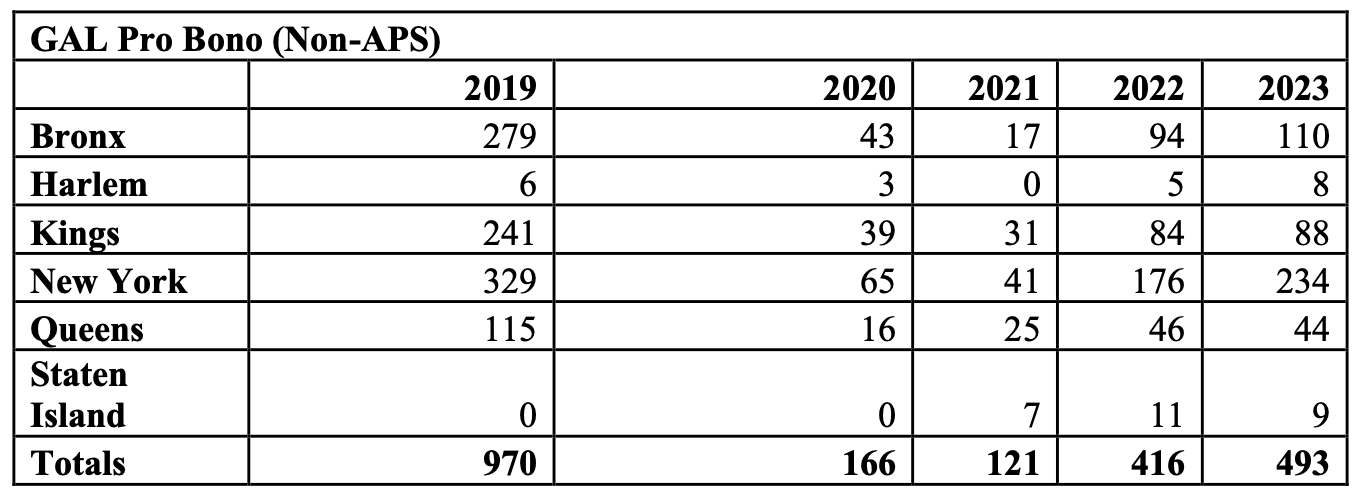
3. Number of GAL pro-bono appointments.
**Note: The numbers below reflect cases that are deemed pro-bono at the time the GAL is appointed. Pro bono status may change over the course of the proceeding. For example, APS may be initially evaluating the impaired litigant for services at the time of the GAL appointment and later determine that they qualify for services while the GAL remains appointed. Also, the impaired litigant’s circumstances may change in such a way that while not initially eligible for APS services at the time of appointment, they later become eligible while the GAL remains appointed.
4. Number of GAL appointments with HRA/APS client designations.
Note: The numbers below reflect cases where the impaired litigant is known to be an APS client at the time the GAL is appointed.
V. IMPROVING GAL WORKING CONDITIONS
GALs report insufficient technical support for their work. Many GALs report that the lack of recognition and support throughout the legal community and civil court system force them to work in isolation, which negatively impacts their service to individuals with diminished capacity. The GALs surveyed believe the working conditions of their service and the operation of the guardian function could be greatly improved by additional office and communications support.
The GALs interviewed universally issued a plea for dedicated office space to afford privacy with wards to engage in confidential conversations in court houses. The provision of such space would allow GALS to interact with their wards in court in ways that promote the wards’ dignity, allowing them an environment to build trust and engage in difficult conversations that promote understanding on both sides. The busy hallways of Housing Court actively interfere with effective communication between GALS and their wards, who frequently need additional time to process their options. These spaces could also be used to afford GALs access to internet-enabled computers, scanners and printers to assist with electronic court filing, applications to government agencies for assistance, and other support for their wards.
Availability of notary publics and transportation assistance, such as transit passes and parking, would also improve a GAL’s functional ability and efficiency. GALs surveyed expressed interest in more direct communication and access to City agencies, including computer databases, direct communication to relevant units, and other resources. Government agencies who provide public resources to avoid eviction of residents and maintain housing could benefit from clearer lines of communication and document sharing, as appropriate.
A. The Human Resources Administration should facilitate greater information sharing and regular communication with GALs.
HRA/APS work and jurisdiction over incapacitated adults are essential to a GAL’s work to find a successful outcome in court for their wards. Delays in HRA approval of wards for APS services after a GAL appointment, failure to communicate with GALs, and APS dropping clients during a proceeding are problematic and negatively affect a GAL’s ability to defend a ward’s rights. Many times, wards cannot be found after APS discontinues services. Further, lack of access to psychological reports, the HRA database and contact information from HRA case workers prevent GALs from being more effective.
B. The Right to Counsel and GAL programs should work together and complement each other to provide the most effective services for wards.
A fully funded and resourced GAL program would allow prompt attention to all wards and facilitate greater communication between wards and legal service providers.
C. Recognition of the importance of GAL work and their role in the court system.
A majority of Guardians Ad Litem surveyed believe their work and role in the legal system should afford more official recognition and respect from the Court, City agencies and attorneys. GALs see themselves as sworn officers of the Court, and more privileges are warranted, such as court identification and access to information databases. Further, GALs believe the dismissive attitude of Court staff and attorneys toward GALs prevents effective work for wards, hampering resolutions. GALs surveyed believe regular communication between GALs and Court staff, enhanced training for judges and court attorneys on the role of the GALs, and more coordination and management would be helpful, including a site supervisor in each courthouse to coordinate and appear when GALs are unavailable. GALs would also benefit from court badges and secure passes to facilitate expedited access to court.
VI. CONCLUSION AND RECOMMENDATIONS
The Guardians Ad Litem surveyed believe their appointments bind them to the Court and legal system in a capacity deserving of equal status with other legal professionals. Although the origin of the GAL program was founded in voluntary service, the nature of the position has changed over time. Their role is recognized as essential to protect elderly and disabled individuals, including those with mental health challenges, and the promise of fair and substantial justice for all. This change has led to uncertainty and confusion on the status of GALs within the administration of the judicial system. Current GALs believe the status of their profession should be enhanced to reflect the important nature of their work and the immense and difficult challenge of serving individuals with a lack of capacity, many who come from low- or no-income households. The lack of resources for GALs creates an over-reliance on City agencies for successful outcomes. These include tracking and locating wards who are APS clients through an active case and worker, HRA heavy duty cleaning services, commencement of Article 81 proceedings, and partial compensation.
The Courts have historically ruled that litigants with diminished capacity shall be protected under the law. The appointment of GALs is a necessary and essential part of the judicial process. As no proceeding may move forward until the issue is resolved, the GAL position can fairly be viewed as important as any other judicial officer, attorney or court staff position. Recognizing the special nature and importance of GAL work challenges the legal community and public to decide if there should be parity in status, and the hard work GALs engage in every day for the Court and the public deserves a re-evaluation of GAL compensation and working conditions.
Therefore, New York City Bar Association’s Sub-committee on NYC Housing Court 12 Guardian Ad Litem Program makes the following recommendations:
- 1) Compensate GALs for all cases.
- 2) Provide confidential space within housing court.
- 3) Provide technology resources within housing court including computers, printers, andaccess to court record systems.
- 4) Provide access to government information systems that care for individuals with a lack ofcapacity as appropriate.
- 5) Provide transit and fare assistance.
- 6) Provide court badges and security IDs.
Housing Court Committee
Jennifer E. Hudson and Ronald S. Languedoc, Co-Chairs
Subcommittee on NYC Housing Court Article 12 Guardian Ad Litem Program
Charles McMellon, Chair
Lauren Price and Nora Ule Rose, Members